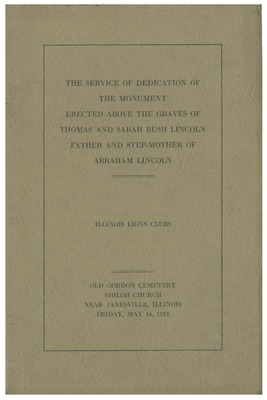

Pamphlets
This sub collection of the Frank and Virginia Williams Collection of Lincolniana consists of approximately 900 pamphlets.
-
Report of the ""Draft riot"" in Boston, July 14th, 1863.
Stephen Cabot
From the diary of Major Stephen Cabot, 1st Batt. Mass. Vol. Heavy Artillery, who had command of Cooper Street Armory the night of the riot.
-
The red flag in John Bull's eyes
Frances Power Cobbe
This pamphlet refutes the argument that emancipation of the American Negroes would lead to a ""renewal of St. Domingo massacres"".
-
Letter of Peter Cooper on Slave Emancipation
Peter Cooper
Wrapper title. At head of title: Loyal Publication Society, 863 Broadway. No. 23; Letter is addressed to Abraham Lincoln and dated January, 1862.
-
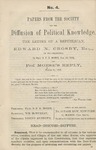
The Letter of a Republican, Edward N. Crosby, Esq., of Poughkeepsie, to Prof. S.F.B. Morse, Feb. 25, 1863: and Prof. Morse's reply, March 2d, 1863.
Edward N. Crosby
Text in two columns; Morse's reply expresses the view that the corner-stone of the U.S. government is the inequality of the white and black races. He quotes from Lincoln's Address on colonization to a deputation of Negroes, Aug. 14, 1862. The Emancipation proclamation is seen as a threat to that cornerstone.
-
The Emancipation Proclamation and Arbitrary Arrests!!
Gilbert Dean
Speech of Hon. Gilbert Dean, of New York, on the governor's annual message, delivered in the House of assembly of the state of New York, February 12, 1863.
-
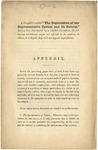
Appendix: The Degradation of our Representative System and its Reform
Joshua Francis Fisher
A pamphlet entitled 'The degradation of our representative system and its reform, ' having been distributed by a limited circulation, the following additional pages are offered to its readers, to whom, it is hoped, they will not appear superfluous.""--Page [47]. A separately issued appendix, that first appeared in: The degradation of our representative system and its reform. Philadelphia : Sherman, Son & Co., 1863.
-
The Degradation of our Representative System and its Reform
Joshua Francis Fisher
Points out the many ways the representative system is failing constituents.
-
Copy of a Letter Written from Buffalo, State of New York: July 23, 1862, to His Excellency, Abraham Lincoln, President of the United States of North America.
Frederick Hasted
Biblical language urging Lincoln to wipe out slavery, also a poem by W.D. Gallagher concerning emancipation""--M. ""The above is published January 26, 1863.""
-
War Power of the President, Summary Imprisonment, Habeas Corpus.
J. Heermas
This pamphlet is an argument describing President Lincoln's use of habeas corpus and the constitutionality of it's use in certain circumstance.
-
Union foundations: a study of American nationality as a fact of science
Edward Bissell Hunt
This pamphlet contains a study of American nationality as a fact of science
-
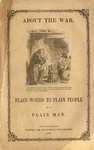
About the war : plain words to plain people / by a plain man.
Ezra Mundy Hunt
Cover title; Illustrated title page; Attributed to E.M. Hunt. Cf. NUC Pre-1956 imprints and Sabin, 33846; Another edition is in German.
-
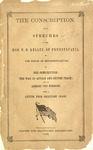
The conscription : also speeches of the Hon. W.D. Kelley, of Pennsylvania, in the House of Representatives, on the conscription, the way to attain and secure peace, and on arming the negroes. With a letter from Secretary Chase.
William Darrah Kelley
The conscription : also speeches of the Hon. W.D. Kelley, of Pennsylvania, in the House of Representatives, on the conscription, the way to attain and secure peace, and on arming the negroes. With a letter from Secretary Chase. "The following article, which is the leading editorial of the Indianapolis Sentinel of March 21, is timely and important. We recognize it as a favorable indication, and publish it with great satisfaction…"
-
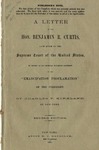
A letter to the Hon. Benjamin R. Curtis: late judge of the Supreme Court of the United States, in review of his recently published pamphlet on the ""Emancipation Proclamation"" of the President
Charles Pickney Kirkland
This pamphlet contains a letter to the Hon. Benjamin R. Curtis, late judge of the Supreme Court of the United States, in review of his recently published pamphlet on the ""Emancipation Proclamation"" of the President.
-
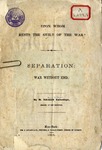
Upon Whom Rests the Guilt of the War?: Separation: War Without End
Edouard Laboulaye
Translation of a paper originally published in the Revue nationale. Page 9: Caption title: ""Disunion: degradation without remedy"".
-
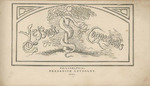
Ye Book of Copperheads.
Charles Godfrey Leland
Illustrated t.p. with ornamental border. Published anonymously. A collection of cartoons and satirical verses. Republished, Indianapolis, 1864, as a campaign document in the presidential campaign. By C.G. Leland and H.P. Leland. Cf. Elizabeth R. Pennell, Charles Godfrey Leland (1906, v. 1, p. 254).
-
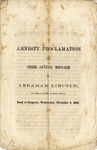
Amnesty Proclamation and, Third annual message of Abraham Lincoln, President of the United States /Read in Congress, Wednesday, December 9, 1863.
Abraham Lincoln
Some of the pages are torn and some content is lost.
-
Message: Fellow Citizens of the Senate and House of Representatives.
Abraham Lincoln
Caption title; signed and dated on p. 13: Abraham Lincoln. December 8, 1863. Proclamation.--Page 14-15.
-
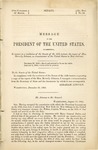
Message of the President of the United States :Transmitting, in Answer to a Resolution of the Senate of the 15th instant, the Report of Hon. Reverdy Johnson, as Commissioner of the United States in New Orleans.
Abraham Lincoln
December 23, 1862. Read and ordered to lie on the table. January 8, 1863. Ordered to be printed.
-
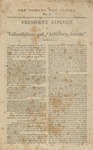
President Lincoln on Vallandigham and ""Arbitrary Arrests.""
Abraham Lincoln
The Tribune War Tracts, no. 5.
-
President Lincoln's views : an important letter on the principles involved in the Vallandigham case
Abraham Lincoln
This pamphlet includes and letter and resolution addressed to President Lincoln from the May 19,1863 democratic meeting followed by the president's reply. The democrats' resolution covers the topic of the committee's view of the principles involved in the Vallandigham case. Clement Laird Vallandigham was an Ohio politician and leader of the Copperhead faction of anti-war Democrats during the American Civil War. In 1863, he was convicted at an Army court martial of opposing the war, and exiled to the Confederacy. In the resolution, the democratic committee denounces such action citing that it infringes on the constitutional right to freedom of speech. In his reply, President Lincoln apposes that view.
-
The War Policy of the Administration: Letter of the President to the Union Mass Convention at Springfield, Illinois.
Abraham Lincoln
Includes letters from Abraham Lincoln and Edward Everett.
![Union and Secession.: Speech of Hon. Thompson Campbell, of San Francisco, Delivered at Sacramento, July 30th, 1863./ [Reported in Phonographic Short Hand, for the Sacramento Union, by A.J. Marsh.]. by Thompson Campbell](https://scholarsjunction.msstate.edu/fvw-pamphlets/1507/thumbnail.jpg "Union and Secession.: Speech of Hon. Thompson Campbell, of San Francisco, Delivered at Sacramento, July 30th, 1863./ [Reported in Phonographic Short Hand, for the Sacramento Union, by A.J. Marsh.]. by Thompson Campbell")